
Navigating Market Dynamics: AI, India’s Position, and Technical Indicators
Agarwal & Choksi July 24, 2026 4 min read
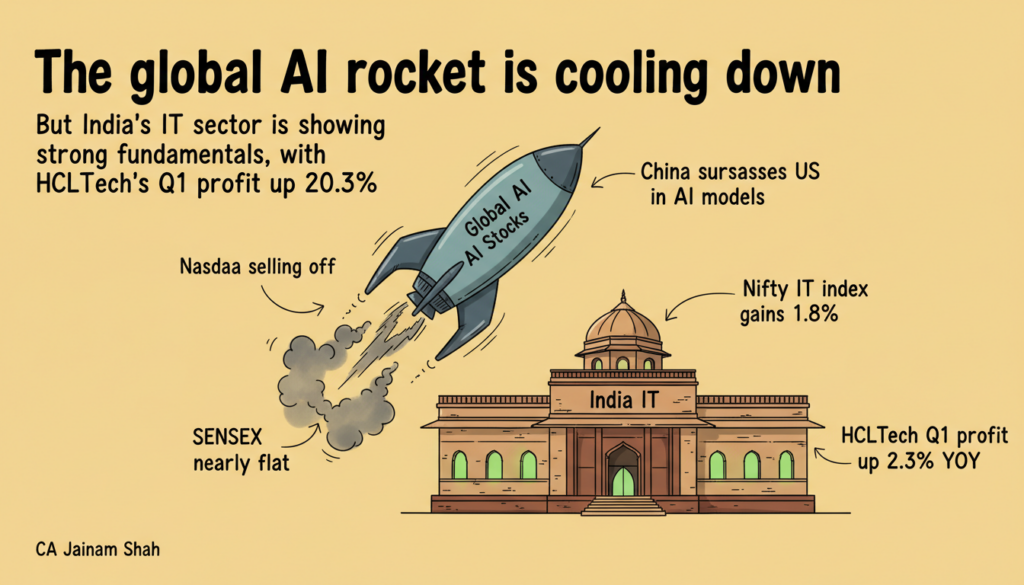
The global financial landscape is currently influenced by several interconnected factors, including the evolving narrative around Artificial Intelligence (AI) stocks, India’s market performance, and the persistent relevance of technical analysis. Understanding these dynamics is crucial for investors and professionals to make informed decisions in a volatile environment.
The Shifting Sands of AI Investments
Recent observations suggest a potential cooling in the performance of AI-based stocks globally. While some interpret this as a temporary consolidation or base-building phase for the AI trade, others see it as a broader market indicator. For instance, the Nasdaq has shown signs of selling off, while the Russell 2000 small-cap index has extended its lead in year-to-date price returns. This divergence could indicate a rotation within the market, moving away from some of the high-flying AI names.
Despite these shifts, the long-term outlook for AI remains a subject of discussion. Nvidia CEO Jensen Huang recently stated that the AI boom is "still at the beginning" of its cycle, suggesting significant growth potential ahead. However, this perspective is met with some skepticism, with certain market participants expressing a bearish view on the broader market, partly due to the high valuations seen in the AI sector.
Adding another layer to the AI narrative is the competitive landscape. China has reportedly surpassed the US in AI frontier models, indicating a global race in AI development. This competition, particularly the rise of open-source models like Kimi-K3, which has reportedly outperformed closed models, raises questions about the long-term profitability of companies that have invested heavily in proprietary AI solutions.
India’s Market Resilience Amid Global Cues
In contrast to some of the global uncertainties, the Indian markets have shown a mixed but generally stable performance. On July 16, 2026, the SENSEX closed nearly flat, up just 1.44 points, while the NIFTY 50 ended slightly down by 0.02%. The BANK NIFTY also closed in negative territory. This mixed breadth was further evidenced by the broader markets, with the MidCap 100 and SmallCap 100 indices both declining.
Sector-specific performance provided some positive highlights. IT stocks, for example, led the session with the Nifty IT index gaining 1.8%, driven by strong Q1 results from companies like TCS and HCLTech. HCLTech, in particular, reported a 20.3% year-on-year increase in Q1 FY27 net profit and a 13.9% rise in revenue, further bolstered by a significant digital transformation deal. Consumer Durables also saw gains, while Realty and banking stocks faced headwinds. Brent crude prices above $85, influenced by US-Iran tensions, contributed to cautious sentiment.
Upcoming results from major Indian companies like Reliance Industries, Wipro, and Tech Mahindra are expected to provide further direction to the market.
The Role of Technical Analysis and Market Memory
Technical analysis continues to play a significant role in market interpretation. Concepts like market memory, where past price failures become reference points for future movements, are actively used by professionals. Volume-based indicators, often referred to as Market Generated Vol Info (MGI), are considered more fluid and indicative of market acceptance or rejection compared to price-based formulas.
For instance, the movement of a stock like GE Vernova, which recently closed below its 50-day moving average, is a technical signal that some analysts track closely. Historical data suggests that such a breach has, in the past, preceded a decline. Similarly, specific price actions, such as testing a failure zone and then retracing, are interpreted as non-coincidental events by those who believe in the market’s inherent memory and the significance of volume analysis.
What this means in practice
For practitioners and investors, the current market environment underscores the importance of a nuanced approach. While the long-term potential of AI remains compelling, the immediate term may see continued volatility and sector rotation. Monitoring global AI developments, including the rise of open-source models and international competition, is essential. In India, sector-specific performance and upcoming corporate earnings will be key drivers. Furthermore, integrating technical analysis, particularly volume-based indicators and an understanding of market memory, can provide valuable insights into short-term price movements and potential turning points. A dynamic asset allocation strategy, which adjusts between different asset classes based on changing market conditions, could also be a prudent approach, allowing for flexibility without constant manual intervention.
Key takeaways
- Global AI stocks are experiencing a period of re-evaluation, with some signs of cooling, though the long-term growth potential is still debated.
- China’s advancements in AI frontier models highlight increasing global competition in the sector, with open-source models gaining prominence.
- Indian markets show mixed performance, with IT and Consumer Durables sectors performing well, while broader markets exhibit some weakness.
- Upcoming Q1 results from major Indian companies will be critical for market direction.
- Technical analysis, including market memory and volume-based indicators, remains a relevant tool for understanding market movements and identifying potential trends.
- A dynamic approach to portfolio management, adjusting to market conditions, can help navigate current volatilities.
This article is for general information only and does not constitute professional advice. Please consult the firm for advice specific to your circumstances.