
A bid of Rs 81 per share won the IDBI Bank deal.
Agarwal & Choksi October 15, 2026 2 min read
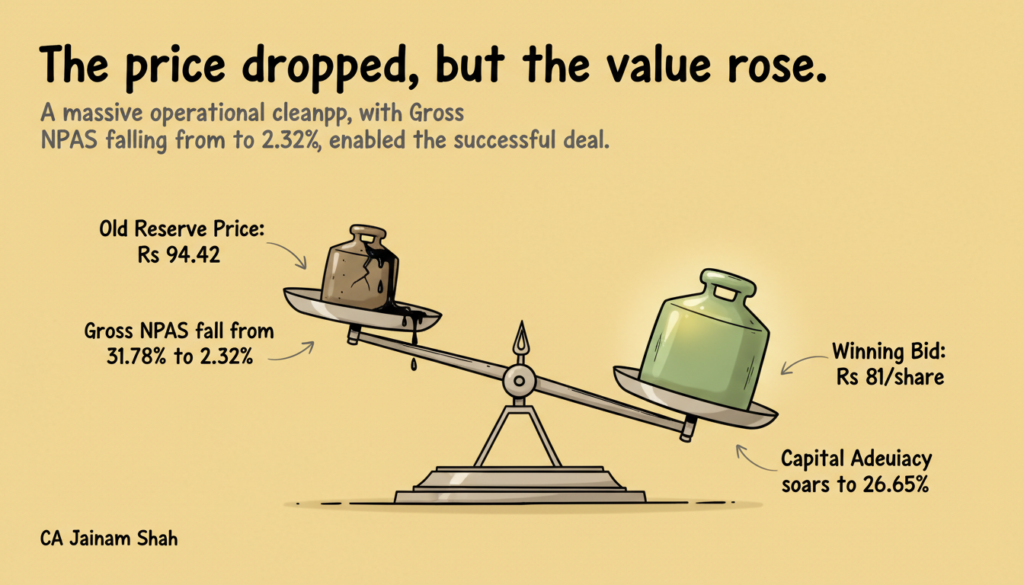
A bid of Rs 81 per share won the IDBI Bank deal. But an earlier round of bidding failed because offers were below a reserve price of Rs 94.42. What changed?
The valuation mechanism holds the key.
..
The transaction involves the government (30.48%) and LIC (30.24%) selling a combined majority stake. But they are not exiting completely. Post-sale, the government will hold 15% and LIC 19%, taking their combined stake to 34%. This is a strategic restructuring, not a full exit.
..
The pricing journey is the most instructive part for any founder or CFO.
The first attempt to sell in FY25-26 failed. The bids received were below the government's reserve price of Rs 94.42 per share.
For the second attempt in FY27, the approach was different. Two independent professional valuation agencies were appointed.
Their average fair valuation came to Rs 75.99 per share. This became the new benchmark for evaluating bids.
The successful bid of Rs 81 per share cleared this new, expert-led benchmark.
..
What made the bank attractive at this price was a massive operational cleanup. The bank was under the RBI's Prompt Corrective Action (PCA) framework from 2017 to 2021. Since exiting PCA, the numbers have transformed:
Gross NPAs fell from 31.78% (Sep 2018) to just 2.32% (Mar 2026).
Net NPAs collapsed from 17.30% to a mere 0.15% in the same period.
Capital Adequacy Ratio soared from 6.22% to 26.65%.
This isn't the same bank that was put on the block initially.
..
Think of a company's valuation as a moving weighing scale. On one side, you have past baggage (NPAs, losses). On the other, future potential (profits, growth). The initial reserve price of Rs 94.42 seems to have been set when the scale was still tilted by past issues. The final price of Rs 81 reflects a scale that has dramatically tipped towards future potential, thanks to the turnaround. The government didn't just lower its price; the bank's intrinsic value fundamentally changed.
..
In a strategic sale, the seller doesn't set the price; they set the conditions for the market to reveal it.
This is just my reading of the public data as a valuer. What other factors do you think influence the gap between a seller's initial price expectation and the final market-discovered price in such large deals?
#Valuation #Disinvestment #Banking #CorporateFinance #India
Take this with you
This article is for general information only and does not constitute professional advice. Please consult the firm for advice specific to your circumstances.