
Cash Deposit Mismatch: Why ITAT Can Order a Fresh Tax Assessment
Agarwal & Choksi October 15, 2026 8 min read
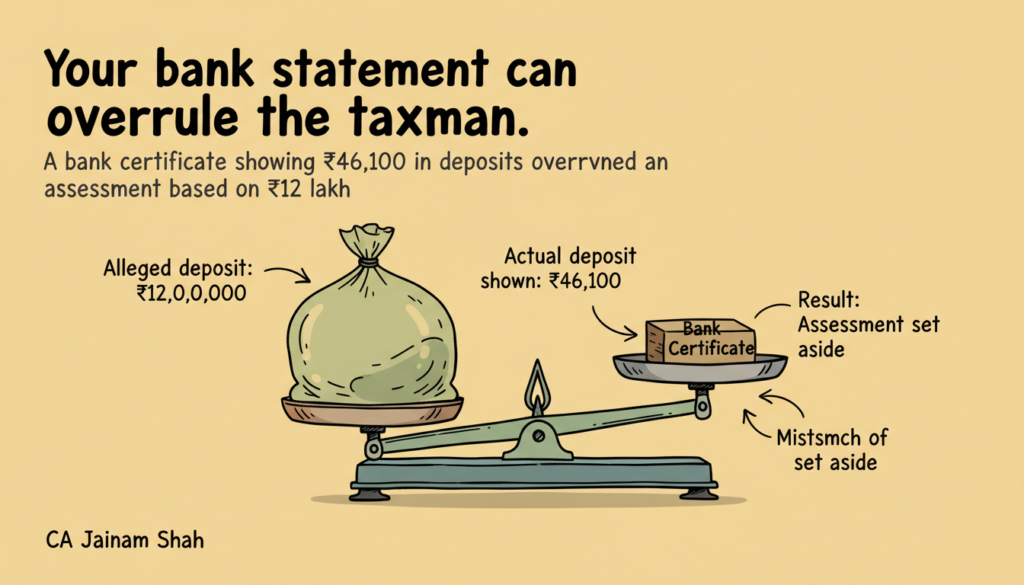
A significant mismatch between cash deposits alleged by the Income Tax Department and the actual figures supported by evidence like a bank certificate can be strong grounds for a fresh assessment. The Income Tax Appellate Tribunal (ITAT) may set aside an assessment order and direct the Assessing Officer (AO) to conduct a new one, especially when procedural fairness is in question. This ensures that all facts are thoroughly examined before a final tax liability is determined, as highlighted in a recent ruling by the ITAT Chennai Bench.
The Core Issue: A ₹12 Lakh Cash Deposit Mismatch
The case of K. Ponnammal Vs ITO for the Assessment Year (AY) 2011-12 provides a crucial lesson for taxpayers. The Assessing Officer, based on departmental information, reopened the assessment under Section 147 of the Income Tax Act, 1961. The information suggested that the assessee had made cash deposits of ₹12,00,000 in her bank account but had not filed an income tax return for the year.
Since the assessee did not respond to the notices, the AO completed an ex parte assessment under Section 144, treating the entire ₹12 lakh as unexplained money under Section 69A of the Act. However, the assessee later produced a bank certificate dated 7th February 2025, which showed total cash deposits of only ₹46,100 during the relevant financial year. This created a material discrepancy of over ₹11.5 lakh.
Faced with this stark contradiction and other procedural issues, the ITAT set aside the orders of the lower authorities. It restored the entire matter to the file of the Assessing Officer for a de novo (fresh) assessment. This directive underscores a fundamental principle: an assessment cannot stand on information that is prima facie contradicted by primary evidence, without proper verification.
Reopening an Assessment: The Power and Responsibility of Section 147
Section 147 grants the Assessing Officer the power to assess or reassess income that has escaped assessment. To invoke this section, the AO must have "reason to believe" that income chargeable to tax has not been assessed. This "reason to believe" cannot be a mere suspicion or a change of opinion; it must be based on tangible material.
In this specific case, the tangible material was the departmental information regarding the ₹12 lakh cash deposit. This formed the basis for issuing a notice under Section 148, which is the mandatory first step to initiate reassessment proceedings. The law requires that this notice be served on the assessee in the prescribed manner. Failure to do so can render the entire reassessment void.
The assessee in the Ponnammal case disputed the proper service of the Section 148 notice, a claim that goes to the very root of the AO’s jurisdiction. The Tribunal noted this contention and, by ordering a fresh assessment, left this critical jurisdictional issue open for the AO to examine and decide upon. This serves as a reminder that procedural compliance, especially the service of the initial notice, is non-negotiable in reassessment proceedings.
The Dangers of an Ex Parte Assessment under Section 144
An ex parte assessment, completed under Section 144, happens when an assessee fails to comply with statutory notices. This could mean failing to file a return, not producing documents, or not responding to specific queries from the department. In such a scenario, the AO is empowered to make the assessment to the best of their judgment based on all relevant material they have gathered.
While this gives the AO authority to finalize an assessment, it carries significant risks for the taxpayer. The AO’s judgment will naturally be based on the information available to them, which may be incomplete or incorrect. As seen in this case, the AO proceeded with the information of a ₹12 lakh deposit, leading to a substantial tax demand without the benefit of the assessee’s explanation or contradictory evidence.
The ITAT took into account the fact that the original assessment was ex parte, and also considered the assessee’s personal circumstances—she was an elderly woman of about 85 years, sparsely educated, and had subsequently passed away. These factors, combined with the substantive factual discrepancies, persuaded the Tribunal that dismissing the appeal on technical grounds would cause a miscarriage of justice. It highlights that while taxpayers must be diligent in responding to notices, the tax system has mechanisms to provide relief where a case has not been heard on its merits due to compelling reasons.
Prioritising Substantial Justice Over Procedural Delays
One of the key hurdles in this case was the significant delay in filing the appeal before the Commissioner of Income-Tax (Appeals) [CIT(A)]. The appeal was filed with a reported delay of 764 days. The CIT(A) was not satisfied with the explanation and dismissed the appeal in limine (at the very outset) without going into the merits of the case.
The assessee’s representative argued that the delay should be recalculated by excluding the period covered by the Supreme Court’s suo motu order extending limitation periods due to the COVID-19 pandemic (from 15th March 2020 to 28th February 2022 was the main period, with some adjustments). While the ITAT did not explicitly rule on the exact calculation of the delay, its decision to set aside the CIT(A)’s order and restore the matter for a fresh assessment speaks volumes.
The Tribunal implicitly chose to prioritise substantial justice over procedural technicalities. It recognised that the dismissal of the appeal on grounds of delay had prevented any adjudication on the core issues: the validity of the reassessment, the service of notices, and the massive factual discrepancy in the cash deposit amount. By restoring the case for a de novo assessment, the ITAT ensured that the legal representative of the deceased assessee would get a reasonable and effective opportunity to present their case on all grounds.
Frequently asked questions
What is a ‘de novo’ assessment?
A de novo assessment means a completely new or fresh assessment. When a higher authority orders a de novo assessment, it sets aside the previous assessment order entirely. The Assessing Officer must then conduct the proceedings all over again, from the beginning, giving the assessee a fresh opportunity to be heard and submit evidence.
What is an ‘ex parte’ assessment under Section 144?
An ex parte assessment is a one-sided assessment completed by the Assessing Officer to the best of their judgment. It is done when a taxpayer fails to comply with tax notices, such as not filing a return under Section 139 or not responding to notices under Section 142(1). The AO uses all available information to determine the tax liability.
Why is the service of a notice under Section 148 so important?
The notice under Section 148 is a jurisdictional prerequisite for a reassessment. If the notice is not issued or not served correctly on the assessee as per the law, the Assessing Officer does not acquire the legal authority to conduct the reassessment. Any assessment completed without proper service of the Section 148 notice can be declared invalid and void.
What is Section 69A of the Income Tax Act?
Section 69A deals with ‘unexplained money’. If an assessee is found to be the owner of any money, bullion, jewellery, or other valuable article which is not recorded in their books of account, and they offer no explanation about its nature and source (or the explanation is unsatisfactory), the value of such items may be deemed to be the income of the assessee for that financial year.
Key takeaways
- Verify Departmental Information: Always cross-check any information from the tax department (like AIR/TIS data) with your own primary records, such as bank statements and passbooks.
- Challenge Factual Discrepancies: If there is a material mismatch between the department’s data and your records, challenge it with concrete evidence. A bank certificate can be a powerful tool to rebut allegations of unexplained cash deposits.
- Respond to All Notices: The easiest way to avoid a high-pitched ex parte assessment is to respond to every notice from the Income Tax Department diligently and on time.
- Procedural Compliance is Key: The validity of a reassessment hinges on strict adherence to procedure, especially the proper service of the notice under Section 148. This can be a strong ground for appeal.
- Substantial Justice Can Prevail: Appellate authorities like the ITAT may look beyond procedural delays to ensure a case is decided on its merits, especially in situations involving compelling personal circumstances or glaring factual errors.
- Legal Heirs Must Act: In the unfortunate event of an assessee’s demise during proceedings, it is crucial for the legal heirs to step in, get their status on record, and pursue the case diligently.
This article is for general information only and does not constitute professional advice. Please consult the firm for advice specific to your circumstances.