India’s Economic Pulse: Navigating Credit Growth, Policy Shifts, and Global Headwinds
Agarwal & Choksi July 24, 2026 6 min read
Recent economic data and policy discussions present a complex but crucial picture of the Indian economy. While robust corporate borrowing signals a strong domestic pulse, significant headwinds from global geopolitics and searching questions around domestic policy are creating a challenging environment. Understanding these cross-currents is essential for businesses and investors navigating the current landscape.
The Domestic Engine: A Surge in Corporate Credit
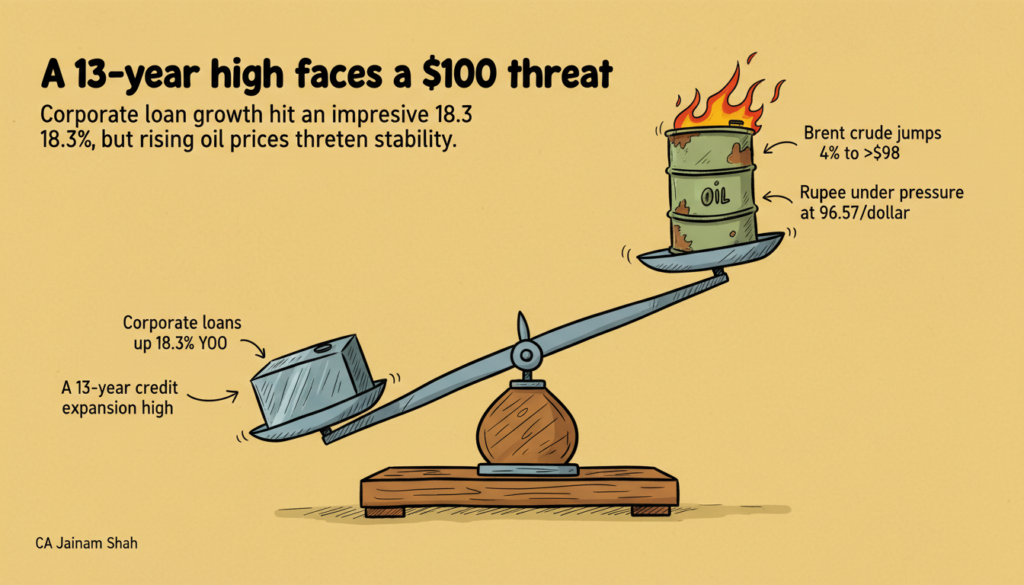
India is currently experiencing its most robust phase of credit expansion since 2012, primarily driven by strong corporate borrowing. According to a report from Morgan Stanley, corporate loan growth accelerated to an impressive 18.3% year-on-year in May 2026, marking a 13-year high. This suggests a sharp revival in borrowing by businesses, supported by sustained domestic demand and the Reserve Bank of India’s regulatory measures.
Interestingly, a majority of lenders have noted that this credit demand, even during the typically soft April-June quarter, is mainly for working capital purposes rather than for greenfield or brownfield projects that would signify new capital investment. This trend is partly fuelled by rising rates in the money markets, which previously served as a cheaper borrowing alternative for corporates. After a period of deleveraging in the wake of the pandemic, companies are now turning back to banks for their financing needs. While the uptick is a positive indicator of business activity, the market is still watching for a broader revival in investment-led borrowing.
The Policy Pivot: Reimagining Indian Agriculture
A significant policy shift is being advocated at the highest levels for India’s agricultural sector, which accounts for about 17% of GDP and 43% of employment. The consensus call from policymakers is to move from a production-centric approach towards an income-centric one. Speaking at an event in Delhi, S. Mahendra Dev, chairman of the Economic Advisory Council to the Prime Minister (EAC-PM), noted that while India has successfully moved from a food-deficit to a food-surplus nation, the focus must now be on improving farm incomes.
Ashok Lahiri of NITI Aayog, speaking at the same event, echoed this sentiment, stating that farmers should be seen as “businessmen” who respond to market demand rather than just growing traditional crops like rice and wheat. Both experts highlighted four key areas for this transformation:
- Diversification: Encouraging a shift towards high-value segments like horticulture, fisheries, oilseeds, pulses, and agroforestry to meet changing consumer preferences for fruits, vegetables, dairy, and processed foods.
- Technology Adoption: Increasing the use of modern technologies such as high-yielding seeds, precision agriculture, AI, drones, and remote sensing to boost productivity, which for several crops remains below global benchmarks.
- Post-Harvest Management: Strengthening supply chains and marketing infrastructure to ensure farmers get better prices.
- Market Reforms: Providing farmers with better access to markets. Dev cautioned that diversification will only happen if alternative crops offer better returns than traditional staples.
Global Crosswinds: Geopolitics, Trade, and Supply Chains
While domestic activity shows strength, global factors are exerting significant pressure. Renewed geopolitical tensions in the Middle East have become a primary concern. After Yemen’s Houthis said they struck two Saudi oil tankers, Brent crude jumped 4% to over $98 a barrel, putting the psychological $100 mark within reach. For India, a major oil importer, this is a key risk that threatens to increase inflation, slow growth, and widen the current account deficit.
The impact is already visible in the currency markets. The Indian Rupee ended a recent session nearly flat at 96.5725 per dollar, but only after state-run banks, likely acting for the RBI, intervened to blunt the pressure. Analysts at BofA Global Research noted that the spike in oil prices has led to an unwinding of long INR positions and could lead to portfolio outflows from both equity and debt markets.
This volatility is also affecting global corporations. Dow Chemical warned that the near shutdown of the Strait of Hormuz has disrupted petrochemical flows, tightening supply and increasing prices. The company is responding with a cost-cutting program, “Transform to Outperform,” expected to generate over $1.3 billion in gains for the year to offset these pressures.
Simultaneously, India’s own trade policies are under scrutiny at the World Trade Organization (WTO). Members raised concerns about predictability and transparency regarding India’s tariff changes, export restrictions, and licensing requirements. India defended its Production Linked Incentive (PLI) schemes and Quality Control Orders (QCOs) as necessary to achieve legitimate public policy objectives, support domestic manufacturing, and safeguard farmers’ livelihoods.
Corporate Governance and Innovation Under Scrutiny
Specific corporate developments highlight the ongoing importance of governance and risk management. HDFC Bank is facing investigations from three US law firms—Glancy Prongay & Murray, the Law Offices of Howard G. Smith, and the Law Offices of Frank R. Cruz. The probes concern allegations that the bank made payments, booked as marketing expenses, to a Maharashtra state agency to attract large deposits. Following the report, the bank’s NYSE-listed American Depositary Receipts (ADRs) fell approximately 4.1% on May 27, 2026, which the firms cite as evidence of financial harm to shareholders. The bank has strongly refuted the allegations.
In the technology sphere, Tesla CEO Elon Musk highlighted a different kind of risk: the challenge of scaling innovation responsibly. Speaking about the company’s robotaxi ambitions, Musk said that while the goal is to scale rapidly, they must be extremely cautious to avoid causing any injuries. He noted that a single accident involving a robotaxi would become “worldwide headline news” and could lead to an immediate regulatory clampdown. This illustrates the tightrope walk between aggressive growth and risk mitigation in cutting-edge industries.
This theme of accountability resonates in the domestic sphere as well, with widespread calls for transparency and stern action following the NEET paper leak, an issue that Karnataka’s Chief Minister said affects the future of lakhs of students and the credibility of India’s education system.
What this means in practice
For practitioners and investors, the current environment demands a nuanced approach. The strong corporate credit growth is a positive sign for banking sector health and business activity, but it is crucial to monitor whether this translates into capital expenditure. The clear policy direction in agriculture opens up long-term opportunities in agri-tech, food processing, logistics, and high-value crop supply chains.
At the same time, you must actively manage external risks. The direct link between Middle East tensions, oil prices, and the Rupee’s stability underscores the need for robust hedging and risk management strategies. For businesses, supply chain resilience remains paramount. Finally, the scrutiny faced by HDFC Bank serves as a reminder that corporate governance and regulatory compliance are critical risk factors, especially for companies with international listings.
Key takeaways
- India’s corporate credit growth is at a 13-year high, but is currently driven more by working capital demand than new investment.
- A major policy push is underway to transform Indian agriculture from a production-based to an income-centric model, focusing on diversification and technology.
- Geopolitical tensions in the Middle East are a direct and immediate threat to India’s economy through higher oil prices, a weaker rupee, and potential portfolio outflows.
- India’s domestic-focused trade policies are facing scrutiny at the WTO, highlighting the ongoing tension between national industrial strategy and global trade norms.
- Corporate governance, regulatory compliance, and the management of operational risks remain critical areas of focus, as highlighted by recent events concerning HDFC Bank and Tesla.
This article is for general information only and does not constitute professional advice. Please consult the firm for advice specific to your circumstances.